In this thrilling guide, we delve deep into the world of Amigas! We start with the high-end powerhouses that captured our hearts – the Amigas released by Commodore and ESCOM and end with the low-end powerhouses! That can also be transformed to high-end ones!
The guide starts with the legendary high-end big box Amiga computers that was released first. Then we cover the low-end models to the cutting-edge multimedia machines.
Get ready to explore the rich history of these incredible computers!
v0.74 – 19-03-2026


Amiga 1000 – The Revolutionary Pioneer
History
The Amiga 1000, born in July 1985, was a groundbreaking computer that forever changed the landscape of personal computing. It boasted advanced graphics capabilities and a powerful Motorola 68000 CPU running at an impressive 7.14 MHz, which outclassed its competitors.
The Amiga 1000’s arsenal also included 256 KB of RAM (expandable to 512 KB, and upto 2GB with PiStorm), and the innovative OCS (Original Custom Chipset) that revolutionized graphics processing with hardware-accelerated sprites, blitting, and display list management. It was Sanyo in Japan that made the first 30000 Amiga 1000 machines.
Technical Specifications for Amiga 1000
| Component | Details | Expandable/Upgradable |
|---|---|---|
| CPU | Motorola 68000 (upgradeable via accelerator or replacement CPU solutions) | Yes |
| Clock Speed | 7.14 MHz | Yes |
| RAM | 256 KB Chip RAM (up to 2 GB with PiStorm) | Yes |
| Custom Chipset | OCS (Original Custom Chipset) | No (*RTG Yes) |
| Sound Chip | Paula (stereo audio, digitized effects, voice) | No |
| Storage | 880 KB 3.5″ floppy disk drive | Yes |
| Expansion Slots | Zorro I slots | Yes |
Conclusion and Price
The Amiga 1000, a groundbreaking computer, made its debut on July 23, 1985. Its initial price ranged from $1,285 to $1,295, which is equivalent to roughly $3,800 to $3,830 in today’s money.
This high-end multimedia machine represented a significant investment back then, especially considering that personal computers with similar capabilities were much more affordable or non-existent at the time.
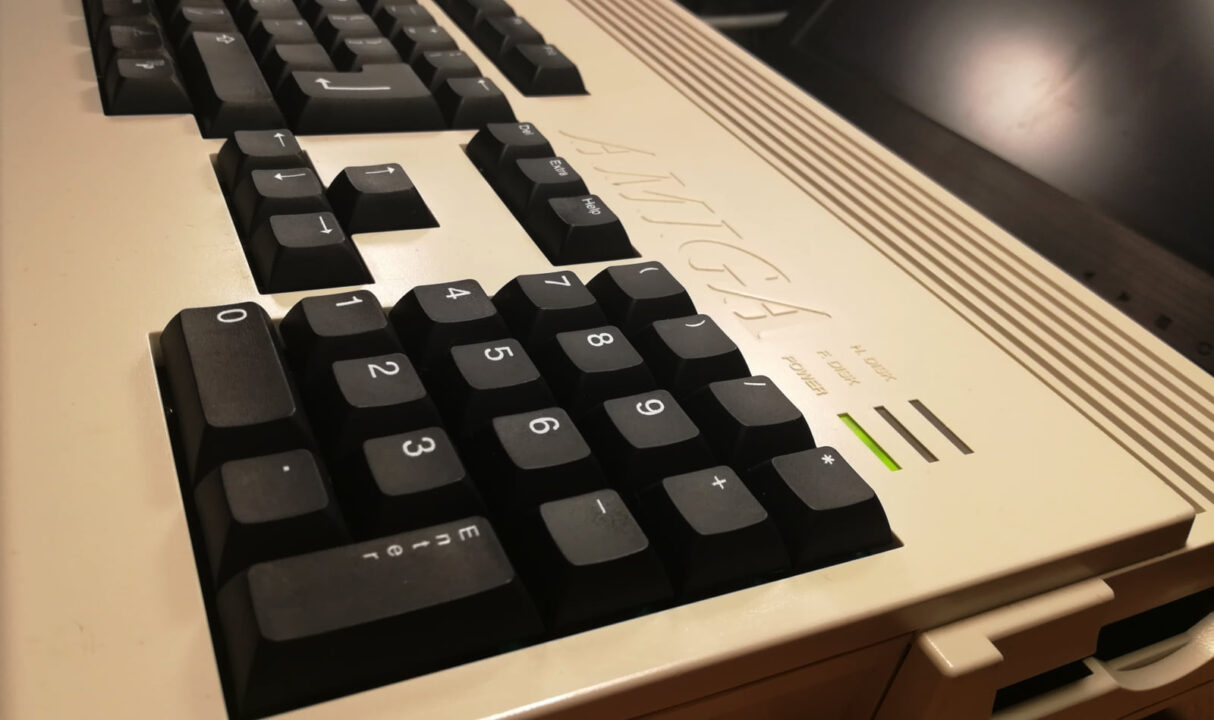
Amiga 2000 – The Big Box Amiga!
History
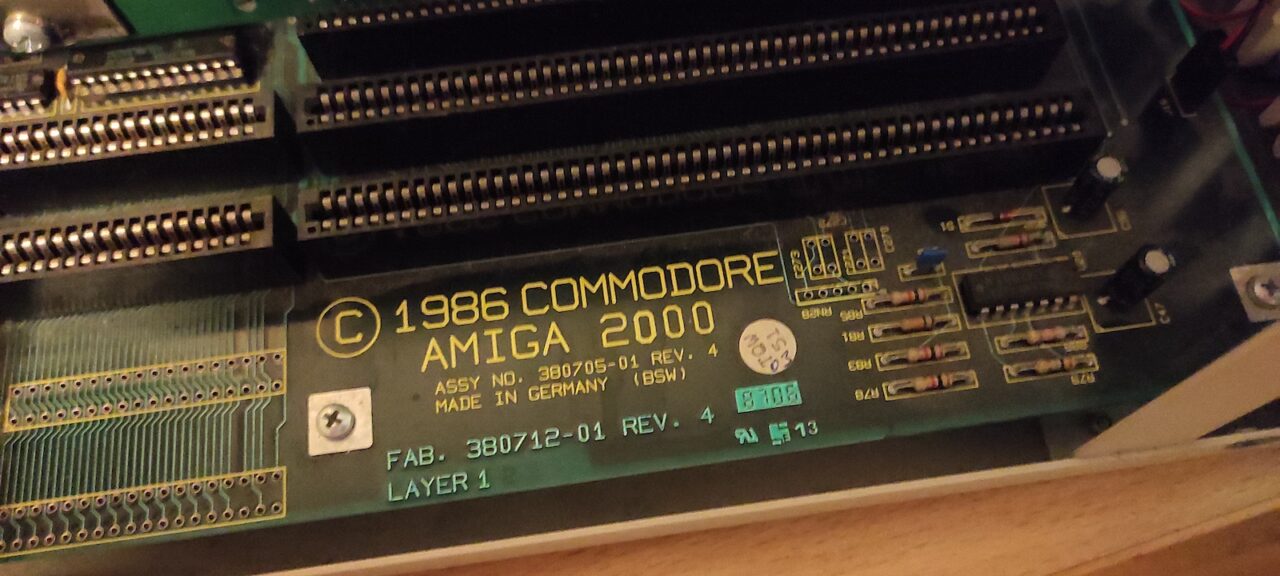
The Amiga 2000 was an innovative computer introduced by Commodore International in 1986. It combined elements of the Amiga 1000 with additional features, including Zorro II expansion slots for increased capabilities. Developed in West Germany and later refined by Dave Haynie’s team, this machine offered advanced graphics and multimedia features that were not available on most PCs or Macs at the time. It had a Motorola 68000 processor running at 7.14 MHz and up to 8MB of RAM, with OCS custom chipset.
The modular design made it easy to upgrade, and today, it’s considered a collector’s item due to its historical significance and rarity within the technology community.
The Amiga 2000 has since become a collector’s item, especially in its original form with the Amiga 1000 motherboard. Its rarity and historical significance make it a cherished piece of technology for enthusiasts like yourself.
Technical Specifications for Amiga 2000
| Component | Details | Expandable/Upgradable |
|---|---|---|
| CPU | Motorola 68000 (upgradeable via accelerator or replacement CPU solutions) | Yes |
| Clock Speed | 7.14 MHz | Yes |
| RAM | 512 KB Chip RAM (expandable, plus Fast RAM via expansion cards) | Yes |
| Custom Chipset | OCS (Original Custom Chipset) | No (*RTG Yes) |
| Sound Chip | Paula (stereo audio, digitized effects, voice) | No |
| Storage | 880 KB 3.5″ floppy disk drive (optional HDD via controller) | Yes |
| Expansion Slots | Zorro II slots | Yes |
| Video Slots | Dedicated video slot for genlocks and video hardware | Yes |
| Modern Enhancements | Supports upgrades such as PiStorm, RTG graphics, networking, and large RAM expansions | Yes |
Other Amiga 2000 variations
The Amiga 2000 was really the very first PC! Before PC became a PC even! From Amiga 2000 in 1986 that was made without the approval from Dave Haynie etc which is known for being the main person behind Amiga 2000 success.
The very first Amiga 2000 came with a motherboard based on the Amiga 1000 motherboard. The Zorro II was experimental, however I have one of those and I’ve never encountered issues. I am using X-Surf Ethernet board with my Amiga 2000 from 1986! The CPU slot is also experimental. My PiStorm Classic sits on top of the 68000 socket, replacing my 68000.
Including Amiga 2000 A and B models,… there was Amiga 1500 and even Amiga 2400 and Amiga 2500. Here are some important facts.
Amiga 1500 – The Amiga 2000 in Europe
The Amiga 1500 was introduced in Europe in 1987 and was essentially a cut-down version of the Amiga 2000. It came with only one floppy disk drive instead of two.
Despite these differences, the Amiga 1500 had a significant impact on the European home computer market. Many people appreciated its affordability and found it to be an excellent platform for gaming and creative work.
The Amiga 1500 was exclusive to Europe and never officially launched in the United States.
Amiga 2500 – The 32-bit Amiga 2000
The Amiga 2500 is an enhanced version of the Amiga 2000. It has a faster processor and better graphics capabilities compared to its predecessor. It was released in 1992 by Commodore International.
It came with enhanced capabilities compared to its predecessor, such as improved memory management and faster data transfer rates. One of the most significant upgrades was the inclusion of a 68020 processor, which offered better performance and multitasking capabilities.
This made the Amiga 2500 a powerful machine for its time, capable of running advanced software and handling multiple tasks simultaneously. In terms of graphics, the Amiga 2500 boasted an enhanced version of the custom chipset found in previous models. This allowed for more vibrant colors and smoother animations, making it a popular choice among artists and gamers.
The Amiga 2500UX however, is another special version of an older computer called the Amiga 2000. It was created to work with something called Commodore Amiga UNIX, or AMIX for short. This machine had some powerful additions, such as a super-fast processor, a tool to connect to other storage devices, and sometimes a big tape drive to help set up the software.
The Amiga 2500UX was mainly used by people who wanted to develop new things on Amiga hardware and showcase how well UNIX System V could work with it.
Conclusion and Price
The Commodore Amiga 2000 was launched on March 1, 1990. The original price for the A2000 was around $1,295 USD at launch. These prices may have varied depending on the region and any additional accessories or configurations chosen by the customer.
Amiga 3000 – A Retro Multimedia Powerhouse!
History
The Amiga 3000 was released in 1990 and marked a significant milestone in the history of personal computers. With its powerful hardware and advanced capabilities, this retro gaming powerhouse captured the imagination of computer enthusiasts around the world. Let’s take a closer look at what made the Amiga 3000 such an iconic machine.
The Amiga 3000 was equipped with a Motorola 68030 CPU, which provided remarkable processing power for its time. It also featured SCSI connectivity, allowing for faster data transfer and more extensive storage options. Additionally, the machine boasted Zorro III slots, enabling users to expand its capabilities with a variety of cards and peripherals.
Technical Specifications for Amiga 3000
| Component | Specification | Expandable/Upgradable |
|---|---|---|
| CPU | Motorola 68030 (upgradeable via CPU accelerator) | Yes |
| Clock Speed | 16MHz (later 25 MHz models) + FPU | Yes |
| RAM | 1 MB (expandable) | Yes |
| Custom Chipset | ECS (Enhanced Chip Set)(AGA on Amiga 3000+) | No (*RTG Yes) |
| Sound Chip | Paula (stereo audio, sampled sound, voice playback) | No |
| Storage | 1.76 MB (HD) 3.5″ floppy drive + Built-in SCSI controller (typical drives from 80 MB) | Yes |
| Expansion Slots | Zorro III slots (faster than Zorro II) | Yes |
Other Amiga 3000 variations
In 1990, Amiga 3000 came out as the successor to Amiga 2000. Yet, the Amiga 2000 was still popular. In the months after Amiga 3000 launch, the Amiga 3000UX came out in co-operation with Sun. The aim was to create cheap UNIX based computers with AmigaOS at its heart and Amix for those wanting to go pro!
But thats not all. Also Amiga 3000T and Amiga 3000+ got airtime. But not for long. Here is info that you need to know.
Amiga 3000UX – The UNIX Amiga!
The Amiga 3000UX is an enhanced version of the original Amiga 3000 computer (above), designed for business and professional users who require powerful multitasking capabilities and advanced networking options. Here are some key features and specifications of the Amiga 3000UX:
- The Amiga 3000UX is powered by a Motorola 68030 processor, clocked at 25 MHz. This high-performance CPU allows for faster multitasking and improved overall system performance compared to the standard Amiga 3000.
- The Amiga 3000UX comes with 4 MB of fast RAM as standard instead of just 2MB, which can be expanded up to 128 MB using additional memory modules because of Zorro III. This increased memory capacity enables users to run larger applications and multitask more efficiently.
- The Amiga 3000UX features the same advanced graphics capabilities as the original Amiga 3000, including support for high-resolution bitmapped graphics and high-speed sprite manipulation. This makes it suitable for tasks such as image processing, animation, and video production.
- Like its predecessor, the Amiga 3000UX includes a built-in Paula audio chip that provides superior sound capabilities, including 8-channel digital audio output, stereo recording, and real-time sample playback. This makes it an excellent choice for music production and multimedia applications.
- Networking: The Amiga 3000UX includes built-in support for Ethernet networking, allowing users to connect to local area networks (LANs) and access shared resources such as files, printers, and communication services. This makes it an ideal platform for office environments where collaboration and data sharing are essential.
In summary, the Amiga 3000UX is a powerful and versatile computer designed for business and professional users who require advanced multitasking capabilities, superior graphics and audio performance, and robust networking support. Its enhanced specifications compared to the original Amiga 3000 make it an attractive choice for those seeking improved system performance and expanded functionality.
Amiga 3000T – The Tower Amiga!
The Amiga 3000T also boasted an expanded memory capacity of up to 144 MB, which was quite impressive for its time. This increased memory provided smoother performance and faster loading times for demanding applications such as 3D modeling and video editing.
One of the most distinctive features of the Amiga 3000T is its imposing size. The large tower case houses the powerful components inside, giving it a formidable presence on any desk. Despite its size, however, the Amiga 3000T remains a highly sought-after collector’s item among retro computer enthusiasts due to its rarity and exceptional performance capabilities.
In conclusion, the Amiga 3000T is a rare and powerful addition to the Amiga lineup. Its unique expanded memory capacity and impressive upgrade capabilities make it an attractive option for those with a passion for retro computing. As a testament to its enduring appeal, it continues to captivate collectors and fans alike more than two decades after its release.
There were two versions of the Amiga 3000T! Amiga 3000T/030 that uses a 68030 and 68882 @ 25 MHz, and the Amiga 3000T/040 that uses a 68040 @ 25 MHz, mounted on the A3640 card. The 040 version has the 68030 and 68882 chips removed from its motherboard.
Amiga 3000+ – The Unknown Amiga!
The Amiga 3000+, also known as the AAmiga 3000+ Advanced Graphics Architecture (AGA) computer, is indeed a rare and powerful gem within the Amiga family. It is the most Unknown AGA Amiga ever created!
While the Amiga 3000+ shares many similarities with its sibling, the AGA chipset that was introduced in the Amiga 3000+ offers significant improvements in terms of graphics capabilities and processing power.
The AGA chipset that you can find in Amiga 1200, Amiga 4000, and Amiga CD32 enabled the Amiga 3000+ to display up to 256 colors simultaneously on its screen, a considerable upgrade from the previous models’ limitations. This feature allowed for more vibrant and detailed graphics, making it popular among artists and gamers alike.
Only very few of Amiga 3000+ were produced. How many is still unknown.
Conclusion and Price
The Amiga 3000, launched in 1990, offered an exceptional value for its time by providing high-end specifications at a lower price point than competing machines from Apple. The Amiga 3000 was released in June 1990 with a launch price of approximately $3,495 USD for the base system. Upon release, it was positioned as a high-end workstation, competing with systems like the Macintosh IIfx, and was equivalent to roughly $8,300–$8,500 in 2025 money.
More advanced configurations or the Amiga 3000UX (Unix) model sold for significantly more, often around $4,998. But still much lower than the Macintosh IIfx.
Equipped with the powerful 68030 processor and 68882 FPU as standard, this computer was truly ahead of its time and helped to solidify Commodore’s reputation for innovative technology in the personal computing market. Together with keyboard and mouse, this price was high, but Commodore managed to keep the price Much lower than its competitor Apple.
Amiga 4000 – The AGA High-End!
History
The Amiga 4000 was introduced by Commodore International in August 1992 as the successor to the highly successful Amiga 3000. The Amiga series had gained a loyal following due to its groundbreaking graphics, sound capabilities, and multi-tasking operating system, which allowed users to run multiple applications simultaneously. This one added AGA! And came with the revolutionary AmigaOS 3.0!
The development of the Amiga 4000 was led by Jay Miner, who had previously designed the earlier models in the series. The goal was to create a powerful workstation capable of handling complex tasks such as video editing, CAD/CAM, and scientific simulations. To achieve this, Commodore equipped the Amiga 4000 with an upgraded Motorola 68040 processor clocked at 25 MHz, which was twice as fast as its predecessor, the Amiga 3000.
In addition to the faster processor, the Amiga 4000 featured a new custom chipset known as Agnus, which improved memory management and allowed for increased RAM capacity. The system also included a Paula sound and AGA display chip, providing better audio quality and video output options.
One of the most significant improvements in the Amiga 4000 was its modular design, allowing users to easily upgrade or expand the system’s capabilities. This made it a popular choice among professionals who needed a flexible and powerful workstation.
Technical Specifications for Amiga 4000
| Component | Details | Expandable/Upgradable |
|---|---|---|
| CPU | Motorola 68040 @ 25 MHz (Amiga 4000/030: 68030 @ 25 MHz) | Yes |
| Clock Speed | 25MHz | Yes |
| RAM | 2 MB Chip RAM (expandable to 2 MB Chip + Fast RAM via CPU cards and Zorro III, up to large modern limits) | Yes |
| Custom Chipset | AGA (Advanced Graphics Architecture) | No (*RTG Yes) |
| Sound Chip | Paula (4-channel stereo audio) | No |
| Storage | IDE controller for hard disks | Yes |
| Floppy Drive | 1.76 MB (HD) 3.5″ floppy drive | Yes |
| Expansion Slots | 4× Zorro III slots | Yes |
| Video Slots | Extended video slot | No |
| Processor Slot | CPU card slot for accelerator upgrades | Yes |
| ISA Slots | 3× ISA slots (inactive by default, usable with bridgeboard) | Yes |
| PCI Slots | ELBOX or DCE Solutions | Yes |
| Clockport | Available on Zorro III expansions* | Yes* |
| Modern Enhancements | Supports upgrades such as PiStorm, RTG graphics, networking, and large RAM expansions | Yes |
Conclusion and Price
The Amiga 4000, launched in 1992, on 21st of October. The price was quite shocking at start with prices way past $2000 mark. However, with the Amiga 1200 release people asked for something in the middle and Commodore decided to release a 68030 version of the Amiga 4000! With a much affordable pricetag at around $1300 this was a brave move by Commodore.
Amiga 500 – The Low-End Masterpiece!
History
The Amiga 500 was launched in 1987 and quickly gained popularity due to its advanced capabilities compared to other home computers at the time. It introduced a new level of multimedia functionality, including high-resolution graphics and sound capabilities.
The Amiga 500 was designed by a team of engineers led by Jay Miner at Commodore International. Miner had previously worked on the Atari VCS (later known as the Atari 2600) and wanted to create a new generation of home computers with advanced graphics and sound capabilities.
The Amiga project started in the early 1980s, and it took several years for Commodore to bring it to market. The company faced various challenges during development, such as financial issues and management changes. However, in the end, the Amiga 500 was released in May 1987, revolutionizing home computing with its groundbreaking features.
Technical Specifications for Amiga 500
| Component | Details | Expandable/Upgradeable |
|---|---|---|
| CPU | Motorola 68000 (upgradeable via accelerator or replacement CPU solution!) | Yes |
| Clock Speed | 7.14 MHz | Yes |
| RAM | 512 KB Chip RAM (expandable to 2MB Chip RAM! Up to 2GB Fast RAM via expansion Modern upgrades such as PiStorm) | Yes |
| Custom Chipset | OCS (Original Chip Set) | No (*RTG Yes) |
| Sound Chip | Paula sound chip with 4-channel stereo sound, supporting digitized audio and voice playback | No |
| Storage | 880 KB 3.5″ floppy disk drive | Yes |
| Expansion | Side expansion port (often referred to as Zorro I compatible) | Yes |
| Modern Enhancements | Supports CPU upgrades such as ACA, networking, and storage solutions via Zorro expansion on left side! – PiStorm, Vampire and Warp can be installed on the 68000 socket! | Yes |
Other Amiga 500 variations
Amiga 500+ The Upgradable ECS!
The Amiga 500+, also known as the ECS (Enhanced Chip Set) Amiga 500, was a powerful addition to the Amiga series and served as a competitor to the Amiga 600 in Norway and other markets. This upgraded version of the popular Amiga 500 introduced several improvements that enhanced its performance and capabilities.
One significant change in the Amiga 500+ was the inclusion of the ECS chipset, which provided faster memory access and improved graphics functionality compared to the original OCS chipset found in the standard Amiga 500. This made the Amiga 500+ an attractive option for gamers and users who wanted a smoother graphics experience.
In terms of hardware configuration, the Amiga 500+ came with 1 MB of Chip RAM, expandable up to 2 MB of Chip RAM and 2GB of Fast RAM. One notable feature was the option to purchase the Amiga 500+ bundled with a hard drive, making it an attractive choice for those who wanted to store large amounts of data or run more demanding applications. In summary, the Amiga 500+ (ECS Amiga 500) represented an exciting evolution in the Amiga series. Its enhanced chipset, improved graphics and sound capabilities, and availability with hard drive bundles made it a competitive option alongside the Amiga 600, Amiga 2500, Amiga 3000 and Amiga CDTV in the Norwegian market and around the world.
Conclusion and Price
The Amiga 500 was launched at a price of $799 in the United States, which was considered quite reasonable for its features and capabilities. It quickly gained popularity among home computer enthusiasts due to its value and performance.
Amiga 600 – The Cutest Amiga Ever!
History
The Amiga 600 is an interesting model. Before it was released, the project was called Amiga 300. Yes, even some Amiga 600 motherboards even still got Amiga 300 label still on.
The Amiga 600 was released in September 1992 as part of the Enhanced Chipset System (ECS) lineup. One major difference between the Amiga 600 and other models is its PCMCIA expansion slot, allowing for more flexible peripheral support. The Amiga 600 features a 68000 processor with an Enhanced Chipset (ECS), which offers improved graphics and sound capabilities compared to earlier models like the Amiga 500. It also comes with 1 MB of Chip RAM, which is double that of the Amiga 500.
Technical Specifications for Amiga 600
| Component | Details | Expandable/Upgradable |
|---|---|---|
| CPU | Motorola 68000 (upgradeable via accelerator or replacement CPU solutions) | Yes |
| Clock Speed | 7.14 MHz | Yes |
| RAM | 1 MB Chip RAM (expandable to 2 MB) | Yes |
| Custom Chipset | ECS (Enhanced Chip Set) | No (*RTG Yes) |
| Sound Chip | Paula (4-channel stereo audio) | No |
| Storage | 3.5″ floppy drive (optional internal IDE hard drive) | Yes |
| Floppy Drive | 880 KB (DD) 3.5″ floppy drive | Yes |
| Expansion | PCMCIA slot, internal expansion header | Yes |
| Video Output | RGB video output | Yes |
| Modern Enhancements | Supports upgrades such as PiStorm, networking, and storage solutions via PCMCIA | Yes |
Conclusion and Price
The original price for the Amiga 600 was around $499.
Amiga 1200 – The Impressive AGA Amiga!
History
The Amiga 1200 was introduced by Commodore International in August 1992, serving as an upgrade from its predecessor, the Amiga 500 and the design factor of the Amiga 600. It featured a blazing fast Motorola 68EC020 processor that ran at 14.78 MHz, with whooping 2MB Chip RAM as the new standard, making it significantly faster than previous models. This speed boost greatly improved the machine’s performance and capabilities.
One of the key features that made the Amiga 1200 stand out was its introduction of an integrated IDE interface. The IDE controller allowed users to connect standard 2.5″ and 3.5″ hard drives, greatly increasing storage capacity compared to previous hard disk controllers. This feature made the Amiga 1200 an attractive option for home users and businesses alike, as it offered a cost-effective solution for larger data storage needs.
Moreover, the Amiga 1200 was known for its impressive multimedia capabilities, which included high-resolution graphics, stereo sound, and advanced animation features. The trapdoor expansion slot underneath the machine made it easy for 3rd party companies to make acclerators for the machine.
These features made it a popular choice for artists, musicians, and game developers alike, contributing to the rich legacy of the Amiga platform in digital culture.
Technical Specifications for Amiga 1200
| Component | Details | Expandable/Upgradeable |
|---|---|---|
| CPU | Motorola 68EC020 (upgradeable via accelerator cards) | Yes |
| Clock Speed | 14.18 MHz | No |
| RAM | 2 MB Chip RAM | No |
| Custom Chipset | AGA (Advanced Graphics Architecture) | No (*RTG Yes) |
| Sound Chip | Paula (4-channel stereo audio) | No |
| Storage | 3.5″ floppy drive, internal IDE controller for hard drives | Yes |
| Floppy Drive | 880 KB (DD) / 1.76 MB (HD) 3.5″ floppy drive | Yes |
| Expansion | PCMCIA slot, trapdoor expansion (CPU/RAM upgrades) | Yes |
| Clockport | Available via internal expansions and add-on hardware | Yes |
| Modern Enhancements | Supports upgrades such as PiStorm, RTG graphics, networking, and large RAM expansions | Yes |
Conclusion and Price
Launched in October 1992, the Amiga 1200 had an initial base price of £399 in the United Kingdom. This pricing reflected its advanced capabilities at that time.