The NodeAmiga project continues to evolve at an impressive pace, with several new updates bringing major improvements to usability, stability, and functionality on Amiga systems.
One of the most important recent additions is the expansion of GUI capabilities. A new graphics sub-module now allows developers to draw directly inside windows using functions such as lines, rectangles, circles, and text rendering. This makes it possible to create more advanced visual applications directly within NodeAmiga, something that was previously quite limited.
Keyboard handling has also been significantly improved. The system now supports arrow keys, function keys (F1–F10), and help key input through RAWKEY events, making navigation and interaction much more responsive and consistent across applications.
Another major step forward is the introduction of several powerful system-level features. These include clipboard access, ARexx integration for inter-process communication, and even an interactive debugger. The debugger allows developers to step through code, inspect variables, and manage breakpoints. It brings a modern development workflow to the Amiga platform.
What is NodeAmiga?
NodeAmiga is a modern JavaScript runtime for AmigaOS that allows developers to create applications using JavaScript. It brings familiar programming concepts from platforms like Node.js to classic Amiga systems, making development faster and more accessible.
Requriment?
68000+, 1 MB RAM, bsdsocket.library (for networking)
Stability has also been a strong focus in recent updates. Numerous fixes have been implemented across the system, including improvements to memory handling, event processing, and the internal virtual machine. These changes help ensure that applications built with NodeAmiga run more reliably, even under heavier workloads.
Scroller handling and GUI interaction have also been refined, with better positioning, improved mouse tracking, and more accurate event detection. Together, these updates make the environment feel more polished and closer to modern expectations.
NodeAmiga is quickly becoming a serious development platform for AmigaOS, bridging modern programming techniques with classic hardware in a way that continues to push the system forward.
AminetBrowser Shows What NodeAmiga Can Do
A new application called AminetBrowser has appeared on Aminet, and it is already becoming an interesting example of what modern development tools such as NodeAmiga can achieve on classic Amiga systems.
What makes AminetBrowser especially notable is that it is built using NodeAmiga!
This means that this application is written using modern JavaScript techniques while still running natively on AmigaOS. Remarkable!
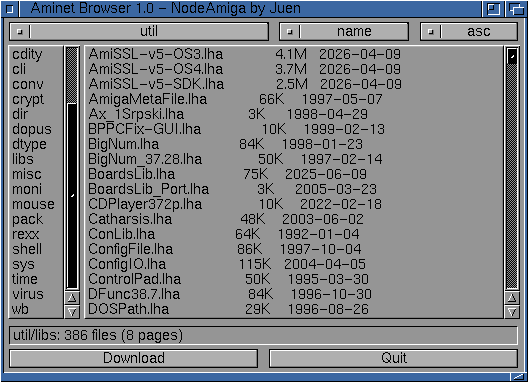
AminetBrowser demonstrates how NodeAmiga is not just a technical experiment, but a practical platform for creating real software.
As the name suggests, AminetBrowser allows users to browse Aminet. The largest and oldest archive of Amiga software directly from their Amiga. Instead of relying on big resource demanding web browsers, external tools or manual downloads.
With this tool users can search, explore, and access software in a more integrated and user-friendly way.
Early development of AminetBrowser
While still early in development, the application highlights an important shift. Traditionally, Amiga software has been developed using languages like C or assembler. With NodeAmiga, developers can now use a more modern and accessible approach, potentially lowering the barrier for new programmers entering the platform.
AminetBrowser also shows how quickly things are evolving. Shortly after recent NodeAmiga updates introduced improved GUI handling, input support, and debugging tools, we are already seeing real applications emerge that take advantage of these features.
This kind of rapid development cycle is increasing more and more in the world of Amiga. It points toward a future where modern development methods and classic hardware can coexist more naturally.
“A complete JavaScript engine and runtime environment for classic Amiga computers. Built from scratch in C, targeting MC68000 and
AmigaOS 2.0+. Inspired by Node.js, adapted for the Amiga platform.“